

Labor Day is the symbolic end of summer. When the temperatures are still running 100 degrees it’s tough to convince yourself that summer is really at an end. I was fortunate enough to have worked remotely from a couple of scenic places. I hope that you were able to get away
Now I wanted to answer questions about flu vaccine and the new Covid 19 vaccine. I had hoped to include the upcoming Medical Letter issue on the new vaccines, but it won’t come out until the end of the month. Here I include a newsletter from UT Health. Following that are two articles from today’s JAMA, The Journal of the AMA, about the safety and effectiveness of flu and Covid -19 vaccines. Lastly, there is some information from The Medical Letter about an new type of flu vaccine as well as info on a new drug that you may have seen advertised on TV, to prevent getting Covid after being exposed.
OPTIMALLY, YOU SHOULD GET THE FLU VACCINE BY THE END OF OCTOBER. IF YOU ARE IN THE OFFICE THIS FALL WE CAN GIVE YOU THE VACCINE THEN. THE NEW COVID VACCINE SHOULD BE IN LOCAL PHARMACIES BY SEPTEMBER 5TH.
OFFICE NEWS: We are trying to survive a software update. They are always pitched as something that will fix all our problems but usually end up causing new ones. This one is no exception. We will endure. Our office building’s facade is getting a facelift. Our office nurse Amber Allen’s son, Caleb, is a new freshman at Texas A+M in College Station. Our MA Lucy Gonzalez’s son is getting a kidney transplant!

Dog Beach, Carmel
Summer COVID wave climbing as flu season looms

COVID cases are climbing in nearly every state. In Texas, there were 2,200 emergency room visits for COVID in the week ending August 22, right as schools were heading back into session. A third of those visits came from the public health region covering South Texas. During the last week of August, the San Perlita Independent School District in the Rio Grande Valley shut down for two days to slow rapid spread among students.
Dr. Jason Bowling, a professor of infectious diseases at UT Health San Antonio and chief epidemiologist at University Health in San Antonio, says the wave hasn’t peaked yet, but it likely will soon.
“I’m hopeful it’ll be in the next week or so,” Bowling said. “It hasn’t been a long, prolonged spike the last two summers, so I’m hopeful this summer we’ll follow that trend.”
For people who’ve been exposed to COVID, there’s a new option beyond the vaccine: incetrovir, sold under the brand name Zocova. Unlike Paxlovid, which is a treatment for people who are already sick and at higher risk of complications, incetrovir is a prophylactic, meant to prevent infection after exposure, particularly for household members of someone who has tested positive.
“You take that medicine within three days of that exposure, and it can reduce your risk of developing COVID yourself,” Bowling said. Like Paxlovid, it’s a five-day course.

The more familiar prevention tool — the vaccine — has been harder to come by this wave. The FDA didn’t approve the updated COVID vaccine until August 27, leaving people turned away from pharmacies like Walgreens and CVS over the last few weeks. Now that approval has come through, shots should become more available. The updated vaccine is approved for everyone over 65, as well as younger people with conditions that raise their risk of severe illness. Bowling suggests you talk with your doctor to consider your risks and health history to decide whether a vaccine is a good choice for you.
As COVID circulates, Bowling is also looking ahead to flu season, which typically doesn’t ramp up until late December or January. But in recent years, cases have started popping up as early as October. That raises the possibility of overlap this year.
“If we’re still seeing COVID kind of tailing down at the end of September, early October, it’s possible we could see some overlap with some early flu cases too,” Bowling said. That means it might be a good idea to get your flu shot now, he added. “Getting the flu vaccine earlier so that you’re protected and already have it on board” makes sense, he said, since it takes a couple of weeks for the immune system to respond.
There is a new prevention option for flu, too. In early August, the FDA approved Moderna’s mRNA flu vaccine, mFlusiva. Because mRNA vaccines don’t rely on egg-based culturing, Bowling said they can be manufactured and adjusted much more quickly than the traditional flu shot. The vaccine is available this year, though it may be harder to find and more expensive than traditional flu shots.
This story is based on an interview with Dr. Jason Bowling, professor of infectious diseases at UT Health San Antonio and chief epidemiologist at University Health San Antonio, for Texas Public Radio’s Petrie Dish. Reporting and hosting by Bonnie Petrie; produced by Jacob Rosati and Dan Katz; editing and sound design by Jacob Rosati.

Grand Canal,Venice
- Description: An mRNA-based trivalent influenza vaccine
- Indication: Prevention of influenza in adults ≥50 years old
- Efficacy: Fewer patients experienced a first episode of influenza-like illness from 14 days post-vaccination through the end of the influenza season with mFLUSIVA than with a standard-dose inactivated influenza vaccine.
- Adverse Effects: Injection-site pain, fatigue, headache, and myalgia were common.
- Dosage: One 0.38-mL IM dose
- Cost: Not yet available
- Conclusion: mFLUSIVA was more effective in preventing influenza illness in adults ≥50 years old than a standard-dose inactivated influenza vaccine in one clinical trial, but it caused more adverse effects.
Outline
- Vaccine Production
- Composition
- Vaccination
- Efficacy
- Adverse Effects
- Dosage, Administration, and Cost
- Conclusion
- References
Table
The FDA has licensed mFLUSIVA (Moderna), the first mRNA-based influenza vaccine in the US, for prevention of influenza in adults ≥50 years old. mFLUSIVA will be available for the 2026-2027 influenza season. Three mRNA COVID-19 vaccines (Comirnaty, Spikevax, and mNEXSPIKE) and one mRNA RSV vaccine (mRESVIA) are also licensed in the US.

VACCINE PRODUCTION — Other influenza vaccines that are available in the US for the 2026-2027 season are prepared through propagation in chicken eggs, culture in mammalian cells, or recombinant technology.1 Egg-based production is time-consuming and can alter antigen conformation, reducing the antigenic match with circulating strains.2 Use of mRNA technology allows for rapid modification of the vaccine formulation to match circulating strains.
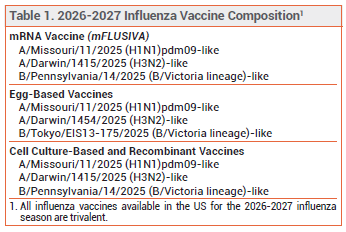
COMPOSITION — mFLUSIVA is composed of three mRNA strands (12.5 mcg of each strand) encoding hemagglutinin glycoproteins of two influenza A viruses and one influenza B virus (see Table 1). Influenza A viruses are the primary cause of influenza-related morbidity and mortality, especially in older adults. Illness caused by influenza B viruses is usually more severe in children, especially those <5 years old.
VACCINATION — Annual vaccination against influenza is recommended in the US for everyone ≥6 months old without a contraindication. Vaccination should ideally be offered in September or October and continue to be offered as long as influenza viruses are circulating in the community. The CDC Advisory Committee on Immunization Practices (ACIP) has recommended that adults ≥65 years old receive either a high-dose (Fluzone High-Dose), adjuvanted (Fluad), or recombinant (Flublok) influenza vaccine; if none of these vaccines are available, any age-appropriate influenza vaccine should be given.3
EFFICACY — In a double-blind trial (Fluent) during the 2024-2025 influenza season, 40,805 adults ≥50 years old were randomized to receive a single dose of the new mRNA-based influenza vaccine or a standard-dose inactivated influenza vaccine (Fluarix in the US). The incidence of a first episode of influenza-like illness from 14 days post-vaccination through the end of the influenza season was lower with the mRNA-based vaccine than with the standard-dose inactivated vaccine (2.0% vs 2.8% in all patients ≥50 years old and 1.9% vs 2.6% in those ≥65 years old). The relative vaccine efficacy of mFLUSIVA was 26.6% in patients ≥50 years old and 27.4% in those ≥65 years old. The relative vaccine efficacy against the A/H1N1, A/H3N2, and B/Victoria strains was 29.6%, 22.2%, and 29.1%, respectively, in all patients.4
ADVERSE EFFECTS — Adverse effects that occurred more frequently with mFLUSIVA than with Fluarix in the Fluent trial included injection-site pain (65.8% vs 29.8%), fatigue (45.1% vs 20.3%), headache (37.8% vs 18.0%), and myalgia (35.4% vs 11.6%).4 As with other seasonal influenza vaccines, most adverse effects of mFLUSIVA were mild to moderate in severity and generally resolved within 1-2 days.
Myocarditis and pericarditis have been reported rarely with mRNA COVID-19 vaccines; cases typically occurred in adolescent and young adult males following the second dose.5 No cases of myocarditis/pericarditis were reported with mFLUSIVA in clinical trials.
Influenza vaccination has been associated with Guillain-Barré syndrome, but the absolute risk is very low (about 1-2 additional cases per million persons vaccinated), and influenza infection itself has been associated with the syndrome (about 17 cases per million patients hospitalized with influenza).6
DOSAGE, ADMINISTRATION, AND COST — mFLUSIVA is supplied in 0.38-mL single-dose prefilled syringes. The vaccine is administered as a single intramuscular dose. No data are available on administration of mFLUSIVA with other vaccines. The cost of mFLUSIVA is not yet available.
CONCLUSION — The new mRNA-based influenza vaccine mFLUSIVA was more effective in preventing influenza illness in adults ≥50 years old than a standard-dose inactivated influenza vaccine in one clinical trial, but it caused more adverse effects. How it compares to vaccines that are preferentially recommended for use in older adults remains to be established.
REFERENCES
- FDA. Influenza vaccine composition for the 2026-2027 U.S. influenza season. March 13, 2026. Available at: https://bit.ly/4xQBc0A. Accessed August 27, 2026.
- JR Chen et al. Better influenza vaccines: an industry perspective. J Biomed Sci 2020; 27:33. doi:10.1186/s12929-020-0626-6
- LA Grohskopf et al. Prevention and control of seasonal influenza with vaccines: recommendations of the Advisory Committee on Immunization Practices – United States, 2025-2026 influenza season. MMWR Morb Mortal Wkly Rep 2025; 74:500. doi:10.15585/mmwr.mm7432a2
- I Leroux-Roels et al. Efficacy and safety of an mRNA seasonal influenza vaccine in adults. N Engl J Med 2026; 394:1803. doi:10.1056/nejmoa2516491
- COVID-19 update: mRNA COVID-19 vaccines and myocarditis. Med Lett Drugs Ther 2025; 67:119.
- A Babazadeh et al. Influenza vaccination and Guillain-Barré syndrome: reality or fear. J Transl Int Med 2019; 7:137. doi:10.2478/jtim-2019-0028
Important Copyright and Disclaimer Message: The Medical Letter® publications are protected by US and international copyright laws. Forwarding, copying, or any distribution of this material without permission to a nonsubscriber is prohibited. Sharing a password with a nonsubscriber or otherwise making the contents of this site available to third parties is prohibited. By accessing and reading the attached content I agree to comply with US and international copyright law and these terms and conditions of The Medical Letter, Inc.
The Medical Letter, Inc. does not warrant that all the material in this publication is accurate and complete in every respect. The Medical Letter, Inc. and its editors shall not be held responsible for any damage resulting from any error, inaccuracy, or omission.

Antinori Winery
ISSUE1759
- Description: An oral SARS-CoV-2 main protease inhibitor
- Indication: Postexposure prophylaxis of COVID-19 in patients ≥12 years old who had contact with an infected individual
- Efficacy: In one clinical trial, a 5-day course of ensitrelvir reduced the incidence of laboratory-confirmed COVID-19, compared to placebo, in household contacts of an infected individual (relative risk 0.33).
- Adverse Effects: Most common were headache, diarrhea, cough, and decreased hemoglobin levels.
- Drug Interactions: Increases serum concentrations of drugs that are CYP3A substrates or are transported by P-gp or BCRP. Use of ensitrelvir with drugs that are primarily metabolized by CYP3A or with strong CYP3A inducers is contraindicated.
- Pregnancy and Lactation: Should not be used by pregnant or breastfeeding women
- Dosage: 375 mg PO on day 1 (taken within 72 hours of exposure), followed by 125 mg on days 2-5
- Cost: A 5-day course costs $1400.
- Conclusion: Ensitrelvir reduces the risk of COVID-19 in household contacts of an individual infected with SARS-CoV-2.
Outline
- Pharmacology
- Clinical Studies
- Adverse Effects
- Drug Interactions
- Pregnancy and Lactation
- Dosage, Administration, and Cost
- Conclusion
- References
Table
The FDA has approved ensitrelvir (Xocova – Shionogi), a SARS-CoV-2 main protease inhibitor, for postexposure prophylaxis of COVID-19 in patients ≥12 years old who had contact with an infected individual. Ensitrelvir is the first oral antiviral drug to be approved in the US for this indication. The parenteral monoclonal antibody combinations bamlanivimab and etesevimab and casirivimab and imdevimab (REGEN-COV) are no longer authorized for postexposure prophylaxis of COVID-19 in the US.


PHARMACOLOGY — Ensitrelvir inhibits SARS-CoV-2 3C-like protease, preventing viral replication.1,2 Because ensitrelvir targets a region of the SARS-CoV-2 virus that is highly conserved, the drug is expected to be effective even when the virus mutates and alters the antigenicity of the spike protein. Ensitrelvir treatment has been associated with 3CL protease substitutions that confer reduced susceptibility to the drug in vitro.3
CLINICAL STUDIES — Postexposure Prophylaxis – FDA approval of ensitrelvir was based on the results of a double-blind trial (SCORPIO-PEP) in 2041 household contacts ≥12 years old who were exposed to SARS-CoV-2 but tested negative for SARS-CoV-2 at baseline. Exposed patients were randomized to receive ensitrelvir or placebo once daily for 5 days, started within 72 hours of symptom onset in the index patient. The incidence of laboratory-confirmed COVID-19 within 10 days of treatment was significantly lower with ensitrelvir than with placebo (2.9% vs 9.0%, RR 0.33 [NNT 16.4]).4
Treatment – In one double-blind trial (SCORPIO-SR) in standard-risk adults with mild to moderate COVID-19, ensitrelvir started within 3 days of symptom onset reduced the time to resolution of a composite of 5 typical COVID-19 symptoms (stuffy or runny nose, sore throat, cough, feeling hot or feverish, low energy or tiredness) by one day compared to placebo.5 In another trial (SCORPIO-HR) in nonhospitalized adults with mild to moderate COVID-19 who were at standard or high risk for severe disease, ensitrelvir started with 3 days of symptom onset did not significantly reduce the time to complete resolution of all symptoms (a composite of 15 symptoms including loss of smell or taste) compared to placebo, but it did reduce viral load.6
ADVERSE EFFECTS — The most common adverse effects (frequency ≥1% and greater than with placebo) of ensitrelvir in clinical trials were headache, diarrhea, cough, and decreased hemoglobin levels. Transient decreases in high-density lipoprotein cholesterol (HDL-C) have been reported. Anaphylaxis, angioedema, and urticaria have occurred rarely with use of the drug in other countries.
DRUG INTERACTIONS — Ensitrelvir is a substrate of CYP3A and it inhibits CYP3A, P-glycoprotein (P-gp), and breast cancer resistance protein (BCRP). The drug can increase serum concentrations of drugs that are metabolized by CYP3A or transported by P-gp or BCRP. Coadministration of ensitrelvir and drugs metabolized primarily by CYP3A is contraindicated. Concurrent use with strong CYP3A inducers can reduce serum concentrations of ensitrelvir and is also contraindicated.7
PREGNANCY AND LACTATION — In studies in pregnant animals, administration of ensitrelvir was associated with skeletal malformations and embryofetal death. Females with reproductive potential should use effective contraception during treatment with ensitrelvir and for 2 weeks after the last dose.
Ensitrelvir has been detected in the milk of lactating rats. Breastfeeding should be avoided during treatment with ensitrelvir and for 2 weeks after the last dose.
DOSAGE, ADMINISTRATION, AND COST — Xocova is supplied in 125-mg tablets. The recommended dosage for postexposure prophylaxis is 375 mg on day 1, followed by 125 mg on days 2-5. Treatment should be started as soon as possible and within 72 hours of exposure to an individual infected with SARS-CoV-2. According to the manufacturer, a 5-day course of Xocova costs $1400.
CONCLUSION — The oral antiviral drug ensitrelvir (Xocova) reduces the risk of COVID-19 in household contacts of an individual infected with SARS-CoV-2. The drug is expensive, has the potential to interact with many other drugs, and should not be taken by women who are pregnant or breastfeeding.
REFERENCES
- M Lin et al. Molecular mechanism of ensitrelvir inhibiting SARS-CoV-2 main protease and its variants. Commun Biol 2023; 6:694. doi:10.1038/s42003-023-05071-y
- Y Unoh et al. Discovery of S-217622, a noncovalent oral SARS-CoV-2 3CL protease inhibitor clinical candidate for treating COVID-19. J Med Chem 2022; 65:6499. doi:10.1021/acs.jmedchem.2c00117
- T Uehara et al. Ensitrelvir treatment-emergent amino acid substitutions in SARS-CoV-2 3CLpro detected in the SCORPIO-SR phase 3 trial. Antiviral Res 2025; 236:106097. doi:10.1016/j.antiviral.2025.106097
- FG Hayden et al. Ensitrelvir for COVID-19 postexposure prophylaxis in household contacts. N Engl J Med 2026; 394:1905. doi:10.1056/nejmoa2509306
- H Yotsuyanagi et al. Efficacy and safety of 5-day oral ensitrelvir for patients with mild to moderate COVID-19: the SCORPIO-SR randomized clinical trial. JAMA Netw Open 2024; 7:e2423203. doi:10.1001/jamanetworkopen.2023.54991
- AF Luetkemeyer et al. Ensitrelvir for the treatment of nonhospitalized adults with COVID-19: results from the SCORPIO-HR, phase 3, randomized, double-blind, placebo-controlled trial. Clin Infect Dis 2025; 80:1235. doi:10.1093/cid/ciaf029
- Inhibitors and inducers of CYP enzymes, P-glycoprotein, and other transporters. Med Lett Drugs Ther 2023 January 25 (epub). Available at: www.medicalletter.org/downloads/CYP_PGP_Tables.pdf.


